
Introduction: the August 2026 compliance window
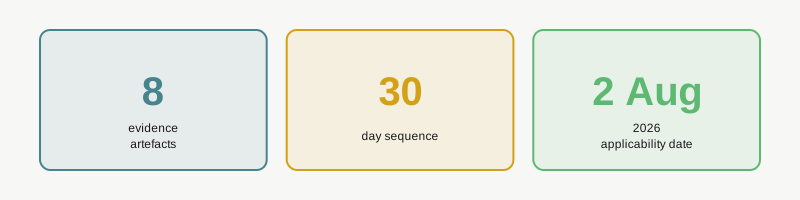
The EU AI Act is no longer a distant compliance exercise. Now that 2 August 2026 has passed, legal, product and engineering teams are being asked the same question in board packs and audit committees: what must we have in place by 2 August, and what can wait? The answer is nuanced. Transparency obligations, deployer duties and escalating GPAI enforcement pressure are live concerns; certain high-risk implementation timelines have shifted under the Commission's simplification agenda. Enterprises that treat 2 August as a single cliff edge will either over-invest in the wrong controls or under-invest in the evidence regulators and customers will actually request.
Last verified: 3 August 2026
What actually changes in August 2026?
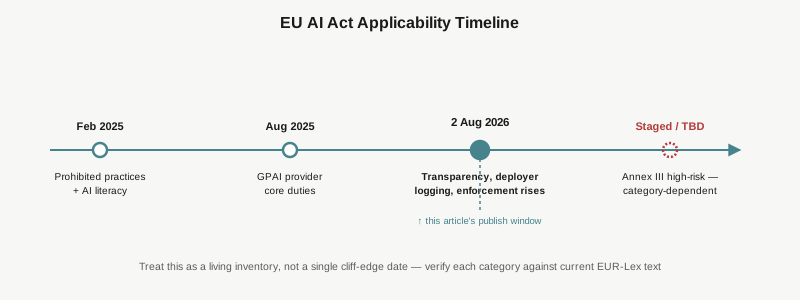
The European Commission positions 2 August 2026 as the date on which the AI Act becomes fully applicable, subject to staged exceptions already written into the regulation and subsequent implementation guidance. For most enterprises, August 2026 matters because:
- Transparency obligations for certain AI interactions and outputs become a practical deployer responsibility — including disclosure that content is AI-generated where required.
- GPAI (general-purpose AI) obligations that became applicable in August 2025 gain sharper enforcement relevance as the broader framework matures.
- Deployer duties — use in accordance with instructions, human oversight where required, logging, monitoring and incident reporting — must be operational, not aspirational.
- Prohibited practices and governance structures (AI literacy, fundamental-rights impact thinking for high-risk contexts) are already in scope for many organisations.
What August 2026 is not is a single switch that activates identical high-risk obligations for every sector on one calendar day. Implementation dates for Annex III high-risk systems and product-embedded AI have been subject to official timetable updates. Your readiness plan must therefore distinguish applies now, applies August 2026, moved later and still being clarified.
What applies now, what moved, and what remains uncertain?
The table below is an implementation lens for enterprise programme owners. Dates reflect official Commission communications as understood at verification; confirm against current EUR-Lex and Commission AI Act pages before legal sign-off.
| Status | Obligation area | Typical enterprise owner | Current applicability | Notes |
|---|---|---|---|---|
| Applies now | Prohibited AI practices | Legal + product | February 2025 onward | Banned manipulative, social-scoring and certain biometric uses |
| Applies now | AI literacy | HR + governance | February 2025 onward | Organisational capability, not a single document |
| Applies now | GPAI provider core duties | Model vendors, internal platform teams | August 2025 onward | Documentation, copyright policy, systemic-risk duties where relevant |
| Applies August 2026 | Transparency (AI interaction / synthetic content) | Product + deployer engineering | 2 August 2026 | Technical marking and user disclosure mechanisms |
| Applies August 2026 | Deployer logging & oversight (where allocated) | Application owners | 2 August 2026 | Must be evidenced in production workflows |
| Applies August 2026 | Broad framework enforcement posture | Compliance + CTO office | 2 August 2026 | Supervisory expectations rise; gaps harder to defer |
| Moved / staged | Annex III high-risk systems (many categories) | Domain product + risk | Staggered post-2026 | Simplification package adjusted timelines — verify per category |
| Moved / staged | Product safety / embedded AI (Annex I) | Engineering + QA | Staged with product cycles | Align with CE/conformity processes |
| Uncertain / evolving | Detailed codes of practice & templates | Compliance | Rolling publication | Use latest Commission and office guidance |
| Uncertain / evolving | Agentic workflows spanning multiple roles | Platform architecture | Interpretation developing | Treat agents as systems with deployer-like duties |
Do not brief executives that every high-risk obligation automatically begins on 2 August 2026. That statement is outdated and will fail scrutiny with informed regulators and customers.
Who is affected: provider, deployer and downstream integrator?
Role allocation drives evidence requirements.
- Providers develop AI systems or GPAI models and place them on the market. They own technical documentation, quality management, post-market monitoring for high-risk contexts and GPAI transparency downstream.
- Deployers use AI under their authority — including internal copilots, customer-facing assistants and decision-support tools. They own operational oversight, logging, input-data quality, worker information and — where allocated — transparency to end users.
- Importers and distributors carry duties when placing third-country systems on the EU market.
Modern enterprises often play multiple roles on one stack: a bank may deploy a vendor LLM (deployer), fine-tune an internal model (provider-like) and expose an agent platform to subsidiaries (distributor-like). The AiRAT EU AI Evidence Pack therefore starts with a role map per system, not a single enterprise-wide label.
Why is proving control harder than declaring compliance?
Policy documents age quickly. Production AI changes weekly: new prompts, tools, retrieval corpora, agent routes and vendor model versions. Regulators and enterprise customers increasingly ask for runtime proof:
- Which model version produced this output?
- Who approved this use case and when?
- What human reviewed this decision?
- What logging exists for transparency obligations?
- How fast can you disable a non-compliant path?
Without an evidence-producing control plane, teams reconstruct answers manually from scattered tickets — too slow for incident response and too fragile for audit.
The AiRAT EU AI Evidence Pack
The AiRAT EU AI Evidence Pack is an eight-artefact minimum set that engineering and governance teams can bind to systems, not slide decks.
- AI system and agent inventory — canonical register of models, agents, prompts, tools and integrations.
- Provider / deployer / importer / distributor role map — per system, per legal entity.
- Risk and use-case classification record — aligned to AI Act categories with reviewer sign-off.
- Human-oversight and decision-rights matrix — who must approve, observe or intervene.
- Model, prompt, tool and data lineage — version metadata on every material inference path.
- Logging and transparency evidence — retention of disclosures, markings and user-facing notices.
- Supplier and GPAI dependency file — contracts, model cards, acceptable-use constraints, subprocessors.
- Incident, rollback and post-market monitoring plan — disable paths, escalation, customer communication.
Each artefact should link to a named owner, review date and storage location in your evidence store.
What does an evidence-producing architecture look like?
Enterprise AI traffic should pass through controls that emit evidence by default:
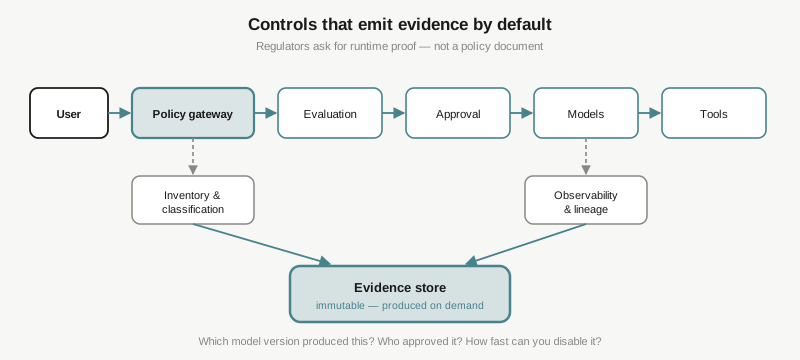
Inventory and classification gate new deployments. Policy gateway enforces allowed models, tools and data classes. Evaluation hooks run pre-release and continuous checks. Human approval captures oversight for sensitive actions. Observability attaches trace IDs, model versions and prompt hashes. Evidence store holds immutable records for audit. Incident control executes disable and rollback with logged rationale.
EU AI Act implementation matrix
| Obligation area | Who owns it | Evidence required | Runtime control | Current applicability |
|---|---|---|---|---|
| Transparency & user disclosure | Product + deployer engineering | UI copy, marking logs, sample sessions | Policy gateway blocks unmarked outputs | August 2026 |
| Deployer logging | Application owner | Immutable logs with user/session IDs | Centralised logging middleware | August 2026 |
| Human oversight | Business + risk | Decision-rights matrix, approval records | Approval service on sensitive paths | As per risk class |
| GPAI supplier diligence | Procurement + platform | Model cards, licences, usage policy | Allowed-model registry | August 2025+ |
| Fundamental rights impact (high-risk) | Legal + risk | FRIA documentation where required | Pre-deployment gate | Staged by category |
| Post-market monitoring | Product operations | Incident register, rollback reports | Kill switch / feature flag | High-risk / GPAI contexts |
| AI literacy | HR + governance | Training records | Onboarding checklist | Now |
| Inventory & classification | AI governance office | Signed inventory export | No uncatalogued production paths | Now (practical necessity) |
Review cadence and the exact statutory article vary by obligation — check the Sources section below before citing a specific article number to legal or a regulator.
What should a 30-day implementation sequence cover?
Days 1–7 — Discover and classify
Export every production model endpoint, agent, embedded vendor API and retrieval index. Assign business and technical owners. Draft role maps.
Days 8–14 — Instrument
Route traffic through a policy gateway. Attach version metadata and trace IDs. Define transparency strings and marking rules for user-facing flows.
Days 15–21 — Oversight and suppliers
Publish human-oversight matrix. Collect GPAI supplier files. Block unapproved models at the gateway.
Days 22–30 — Exercise incidents
Run a tabletop: disable a model route, verify logs, produce an evidence pack sample for one system. Record gaps.
What are common failure modes?
- Policy-only programmes with no production gateway or inventory binding.
- Treating August 2026 as uniform high-risk day one — misallocates engineering effort.
- Vendor blind spots — no file for third-party models used in customer workflows.
- Agent sprawl — agents deployed outside the inventory with broad tool access.
- Logging without lineage — timestamps without model version or prompt hash are weak evidence.
Which readiness metrics should leadership track?
- Percentage of AI assets inventoried with named owners.
- Percentage with signed risk classification.
- Percentage of model calls carrying version metadata.
- Percentage of sensitive actions under human-approval policy.
- Mean time to disable a non-compliant model or agent.
- Percentage of suppliers with complete evidence files.
- Transparency coverage on user-facing AI interactions.
Key takeaways
- August 2026 intensifies enforcement and transparency duties, but high-risk timelines are staged — build a living applicability matrix.
- Compliance is demonstrated through retrievable evidence, not static policies.
- The AiRAT EU AI Evidence Pack gives eight concrete artefacts to align legal, product and engineering.
- Agents and GPAI dependencies multiply role complexity — map provider, deployer and integrator per system.
- A policy gateway plus observability turns obligations into runtime controls with audit trails.
Frequently asked questions
What applies under the EU AI Act on 2 August 2026?
Broad applicability and stronger expectations for transparency, deployer accountability and GPAI-related enforcement apply from 2 August 2026. Prohibited practices, AI literacy and GPAI provider duties are already in force. High-risk system deadlines vary by category and have been adjusted under official implementation timetables — verify per Annex.
Do the August 2026 rules apply to companies outside the EU?
Yes, when they place AI on the EU market or put AI into service in the EU. Extra-territorial reach depends on role (provider, deployer, importer) and where effects occur. Non-EU enterprises serving EU users should map roles per system.
What evidence should an AI deployer retain?
At minimum: inventory entry, classification rationale, instructions followed, oversight records, logs of operation, transparency implementations, supplier files and incident/rollback actions. The AiRAT EU AI Evidence Pack enumerates eight artefact classes.
Are AI-generated text and images required to be labelled?
Transparency obligations require that users know when they interact with certain AI systems and that AI-generated or manipulated content be marked in defined cases. Exact mechanisms depend on use case and modality — implement technical marking and disclosure in product flows.
How should enterprises govern third-party models?
Maintain a GPAI dependency file: model card, licence, acceptable use, subprocessors, version pinning and exit plan. Enforce allowed models at a gateway; do not rely on ad hoc API keys per team.
Is an AI inventory mandatory for practical compliance?
The Act does not always label a spreadsheet "inventory" as such, but you cannot meet deployer duties, oversight, logging or incident response without knowing what runs in production. Inventory is a practical necessity.
How does the EU AI Act apply to AI agents?
Agents are AI systems in operation. Treat each agent workflow as a deployer context: tools, data, oversight, logging and transparency must be evidenced. Multi-agent chains need lineage across delegations.
Sources
- European Commission — Regulatory framework on AI
- EUR-Lex — Regulation (EU) 2024/1689 (AI Act)
- European Commission — AI Act implementation timeline and Q&A
- EU AI Act Service Desk — Official implementation support
Technical disclaimer: This article is technical implementation guidance for engineering and governance teams. It is not legal advice. Confirm obligations, dates and role allocation with qualified counsel against current official texts.
Book an AI governance readiness assessment — Contact AiRAT.
Related: Agentic AI governance and identity · Observability for AI systems · LLM evaluation for procurement · AiRAT services · Resources · Methodology