
Introduction: why "hosted in UAE" is not enough
UAE enterprises are expanding AI adoption across banking, government, energy and retail at the same time as domestic compute capacity scales — including the Stargate UAE programme, whose first 200-megawatt phase is expected in the third quarter of 2026. Procurement teams face a familiar pitch: "sovereign AI, UAE-hosted, compliant."
The risk is conflating residency (where bytes are stored) with sovereignty (who controls keys, models, updates, support access, telemetry and exit). A workload can run in an Abu Dhabi data centre while a foreign provider retains root access, holds encryption keys, routes logs offshore, or controls model update channels. That is hosted locally; it is not operationally sovereign.
This article provides a practical architecture for UAE sovereign AI — covering data, models, keys, cross-border flows and audit evidence — without treating sovereignty as a single checkbox.
Last verified: 3 August 2026
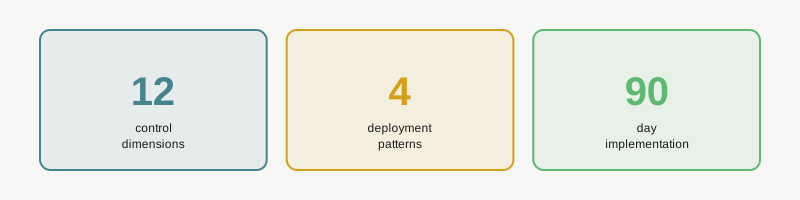
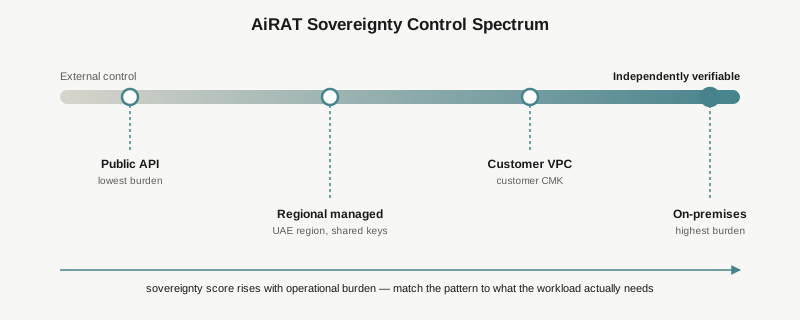
Direct answer: Sovereign AI in the UAE means customer control across twelve dimensions, not just where the data sits. Score data, processing, model endpoints, keys, identity, logs, support, backup, portability and exit with the AiRAT Sovereignty Control Matrix, then match the deployment pattern, public API, regional managed, VPC, or on-premises, to what the workload actually needs. Map legal obligations to the correct entity: federal PDPL, DIFC and ADGM are three different regimes, not one, and cross-border transfer mechanisms need documented evidence, not a contractual assertion.
Definitions: residency, localisation, sovereignty, private AI
| Term | Meaning | Common mistake |
|---|---|---|
| Data residency | Primary data storage geography | Treating residency as sufficient for regulated AI |
| Data localisation | Legal requirement to process/store in jurisdiction | Assuming one UAE-wide rule applies everywhere |
| Sovereign AI | Customer control over data, models, keys and operations | Equating with any in-country hosting |
| Private AI | Models and inference isolated to organisational boundary | Ignoring vendor support and update paths |
UAE infrastructure context (July 2026)
Several developments shape enterprise architecture choices:
- Stargate UAE — a 1-gigawatt AI campus in Abu Dhabi, developed by G42 with partners including OpenAI, Oracle, NVIDIA, Cisco and SoftBank. The first 200MW cluster is targeted for Q3 2026; full buildout timelines extend beyond that phase.
- Domestic hyperscalers and sovereign cloud providers — G42 Cloud, Khazna, e& enterprise cloud and others offer in-country options with varying control models.
- Federal PDPL — Federal Decree-Law No. 45 of 2021 provides the federal data protection floor; sector and free-zone regimes add layers.
- Cross-border transfers — permitted under PDPL with appropriate safeguards; there is no universal ban on all offshore processing for all data categories, but regulated sectors impose additional conditions.
Avoid stating capacity as live until confirmed. Architecture decisions should not depend on marketing timelines.
The AiRAT Sovereignty Control Matrix
The AiRAT Sovereignty Control Matrix evaluates twelve dimensions. Score each:
- External control — provider controls without customer visibility
- Shared control — contractual sharing; limited customer verification
- Customer-controlled — customer holds authority; provider operates within boundary
- Independently verifiable — customer or auditor can confirm control without provider assertion alone
| # | Dimension | What to assess |
|---|---|---|
| 1 | Data location | Where prompts, RAG corpora, outputs and training data reside at rest |
| 2 | Processing location | Where inference and embedding jobs execute |
| 3 | Model weights and endpoint | Who hosts weights; whether inference crosses borders |
| 4 | Compute and orchestration | Who provisions GPUs, containers, agent runtimes |
| 5 | Encryption-key ownership | Customer-managed keys (CMK) vs provider-managed |
| 6 | Identity and privileged access | Admin paths, break-glass, vendor SRE access |
| 7 | Logs and observability | Where telemetry, traces and audit logs land |
| 8 | Support and subprocessors | Who can access production for maintenance |
| 9 | Backup and disaster recovery | DR region, replication paths, restore authority |
| 10 | Model and vendor portability | Export weights, adapters, vector indexes, configs |
| 11 | Legal and contractual jurisdiction | Governing law, dispute forum, government access clauses |
| 12 | Exit and deletion evidence | Provable data and model artefact deletion on termination |
Four deployment patterns
1. Public API (foreign or regional endpoint)
Profile: Enterprise sends prompts to a vendor API; minimal infrastructure ownership.
Sovereignty posture: External to shared control on most matrix dimensions.
Suitable for: Low-sensitivity summarisation with strict data minimisation and no regulated personal data.
2. Regional managed service (UAE region, provider-operated)
Profile: Vendor operates managed AI service in UAE region; customer configures policies.
Sovereignty posture: Strong on data and processing location; shared on keys and support unless CMK and access restrictions are contracted.
Suitable for: Enterprise assistants with PDPL-compliant transfer mechanisms and DPA in place.
3. Customer VPC (customer network boundary)
Profile: Models and data plane inside customer VPC or dedicated tenant; provider manages platform layer.
Sovereignty posture: Customer-controlled on identity, logging and network; shared on model updates unless self-hosted weights.
Suitable for: Banking, telecom and government workloads with sector audit requirements.
4. On-premises / private model
Profile: Weights, inference and RAG stack inside customer data centre or sovereign cloud tenant.
Sovereignty posture: Highest matrix scores; highest operational burden.
Suitable for: Classified, air-gapped or highest-materiality decisioning with in-house ops capacity.
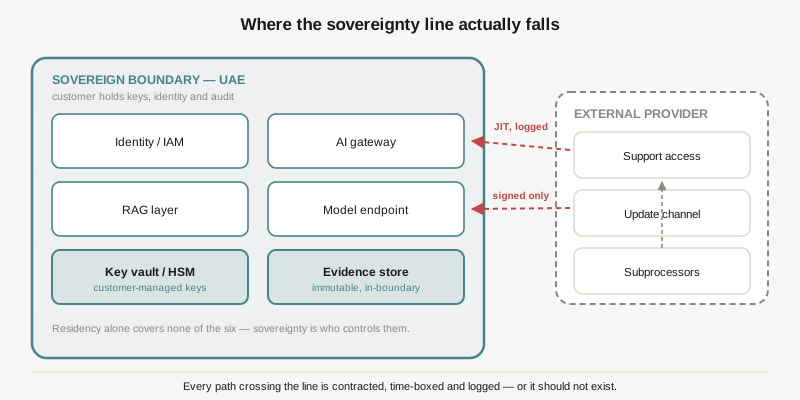
Deployment option comparison
| Deployment model | Data & model location | Key control | Support access | Auditability | Operational burden |
|---|---|---|---|---|---|
| Public API | Provider-defined | Provider | Provider | Low | Lowest |
| Regional managed | UAE region | Shared / CMK option | Contracted | Medium | Low–medium |
| Customer VPC | UAE VPC | Customer CMK | JIT, logged | High | Medium |
| On-premises / private | Customer DC | Customer HSM | Customer ops | Highest | Highest |
Key ownership and privileged access
Encryption keys are the sovereignty hinge. Minimum expectations for regulated workloads:
- Customer-managed keys in UAE-region HSM or cloud KMS with customer-held root of trust.
- Provider key escrow prohibited for highest-sensitivity tiers unless contractually justified and audited.
- Break-glass access — time-limited, dual-authorised, fully logged; never standing root.
- Separation of duties — model operators cannot unilaterally export production corpora.
For observability architecture that supports audit, see Observability for AI systems.
RAG and enterprise-data boundaries
Retrieval-augmented generation introduces data paths that residency checklists often miss:
- Embedding pipelines — where are vectors computed and stored?
- Chunk storage — do vector DB replicas cross regions?
- Query logs — do prompts containing customer PII leave the boundary?
- Re-embedding on model change — portability of indexes when models update
Policy: classify corpora by sensitivity; route each class to a deployment pattern that meets its matrix score, not your enterprise average.
Model updates, telemetry and cross-border flows
| Flow type | Risk | Control |
|---|---|---|
| Model weight updates | Supply chain / behaviour change | Signed artefacts; staging validation; rollback |
| Fine-tuning exports | Data exfiltration | Air-gapped training; output review |
| Usage telemetry | Indirect data leakage | Telemetry minimisation; in-boundary aggregation |
| Support sessions | Privileged access | JIT; recording; customer approval |
| DR replication | Unintended residency breach | Contractual region lock; encryption in transit |
Under UAE PDPL, cross-border transfers require appropriate safeguards — adequacy, standard contractual clauses, or binding corporate rules as applicable. DIFC and ADGM have separate transfer regimes. Do not assume one policy covers all entities in a group structure.
Portability, exit and disaster recovery
An AI exit plan is not a generic cloud exit checklist. It must cover:
- Export of model weights, adapters, LoRA checkpoints and configuration.
- Vector index and embedding schema export.
- Prompt templates, policy rules and evaluation datasets.
- Deletion certificates — cryptographic or auditor-verified evidence that provider copies are destroyed.
- DR failover that does not silently shift processing to non-UAE regions.
Production controls
| Control | Implementation |
|---|---|
| Data classification | Tag corpora; block upward routing to weaker patterns |
| AI gateway | Central policy enforcement, logging, rate limits |
| CMK / HSM | Customer root of trust for data and model artefacts at rest |
| Access logging | Immutable audit trail for human and service principals |
| Subprocessor register | Aligned with PDPL Article 22 processor requirements |
| Transfer impact assessment | Document legal basis for each cross-border path |
| Exit rehearsal | Annual test of export and deletion procedures |
Metrics to track
| Metric | Purpose |
|---|---|
| % workloads with matrix assessment | Coverage |
| % regulated data on customer-controlled keys | Key sovereignty |
| Cross-border flow count (documented) | Transfer governance |
| Support access sessions (JIT) | Privileged access hygiene |
| Exit drill success | Portability readiness |
| Model update lag (staging to prod) | Supply chain control |
| Policy violations (data class routing) | Architecture enforcement |
90-day implementation roadmap
| Phase | Weeks | Activities |
|---|---|---|
| Assess | 1–3 | Inventory AI workloads; map legal entities to PDPL / DIFC / ADGM |
| Score | 4–6 | Apply Sovereignty Control Matrix; identify gaps |
| Architect | 7–9 | Select deployment patterns per workload class |
| Implement | 10–11 | Deploy gateway, CMK, logging, DPAs |
| Verify | 12 | Exit drill; auditor review of transfer documentation |
Failure modes
- Residency theatre — symptom: "UAE region" on the slide, keys held offshore. Mitigation: score all twelve matrix dimensions, not the region label alone.
- Shadow API — symptom: teams quietly route regulated data through a foreign public API. Mitigation: enforce at the gateway; run discovery scans for unsanctioned endpoints.
- Orphaned vectors — symptom: embeddings replicate to a disaster-recovery region outside the UAE. Mitigation: contractual region lock, with a replication map you can actually audit.
- Update surprise — symptom: model behaviour changes with no staging step. Mitigation: require signed updates and an evaluation gate before promotion.
- Exit fiction — symptom: the contract claims deletion happens; no evidence it actually did. Mitigation: deletion certificates plus a rehearsed exit drill, not a clause on paper.
- Jurisdiction mix-up — symptom: a DIFC entity treated as if federal PDPL alone applies. Mitigation: map obligations at the legal-entity level, not the group level.
Key takeaways
- Sovereign AI is operational control across twelve dimensions — not a residency checkbox on a procurement form.
- The AiRAT Sovereignty Control Matrix scores data, processing, models, keys, access, logs, support, backup, portability, jurisdiction and exit.
- Four deployment patterns trade sovereignty for burden: public API, regional managed, customer VPC, on-premises/private.
- UAE legal obligations depend on entity jurisdiction — federal PDPL, DIFC and ADGM are not interchangeable.
- RAG, model updates and support access are common hidden cross-border paths.
- Exit plans must cover model artefacts, vector indexes and provable deletion — rehearse annually.
Frequently asked questions
What is sovereign AI?
An architecture in which the customer controls data, processing, models, encryption keys, privileged access, logging and exit — with evidence that does not rely solely on provider assertions.
Is data residency the same as data sovereignty?
No. Residency describes where data is stored. Sovereignty describes who controls keys, operations, support access, model updates and cross-border flows. Data can reside in the UAE without being sovereign.
Does sovereign AI require an on-premises model?
Not always. Customer VPC or dedicated sovereign cloud tenants with customer-managed keys can achieve customer-controlled scores for many workloads. On-premises is typically required only for the highest sensitivity tiers.
How should UAE enterprises control AI encryption keys?
Use customer-managed keys in UAE-region HSM or KMS; prohibit standing provider root; require dual-authorised break-glass with full logging; separate key administration from model operations.
Can a managed cloud service support sovereign AI?
Yes, if contracts and architecture deliver customer-controlled scores on the dimensions that matter for your workload — typically keys, identity, logging, network boundary and exit evidence. A regional label alone is insufficient.
What should be included in an AI exit plan?
Export paths for weights, adapters, vector indexes, policies and evaluation data; subprocessors notification; deletion certificates; and tested timelines. Rehearse before contract renewal pressure.
How should RAG systems protect enterprise data in the UAE?
Classify corpora; keep embedding and retrieval inside the sovereign boundary; minimise query logging; use CMK for vector stores; block re-embedding pipelines that cross regions without transfer assessment.
Sources
- UAE Federal Decree-Law No. 45 of 2021 on the Protection of Personal Data (PDPL): https://u.ae/en/about-the-uae/digital-uae/data/data-protection-laws
- UAE Data Office — PDPL guidance and executive regulations: https://u.ae/en/about-the-uae/digital-uae/data
- G42, Global Tech Alliance Launches Stargate UAE: https://www.g42.ai/resources/news/global-tech-alliance-launches-stargate-uae
- DIFC Data Protection Law (DPL) 2020: https://www.difc.ae/business/laws-regulations/data-protection-law/
- ADGM Data Protection Regulations 2021: https://www.adgm.com/operating-in-adgm/data-protection
This article provides technical architecture guidance only. It is not legal advice. Map obligations to your legal entity and consult qualified UAE counsel.
Related: Observability for AI systems · Agentic AI governance · Methodology · Services · Resources